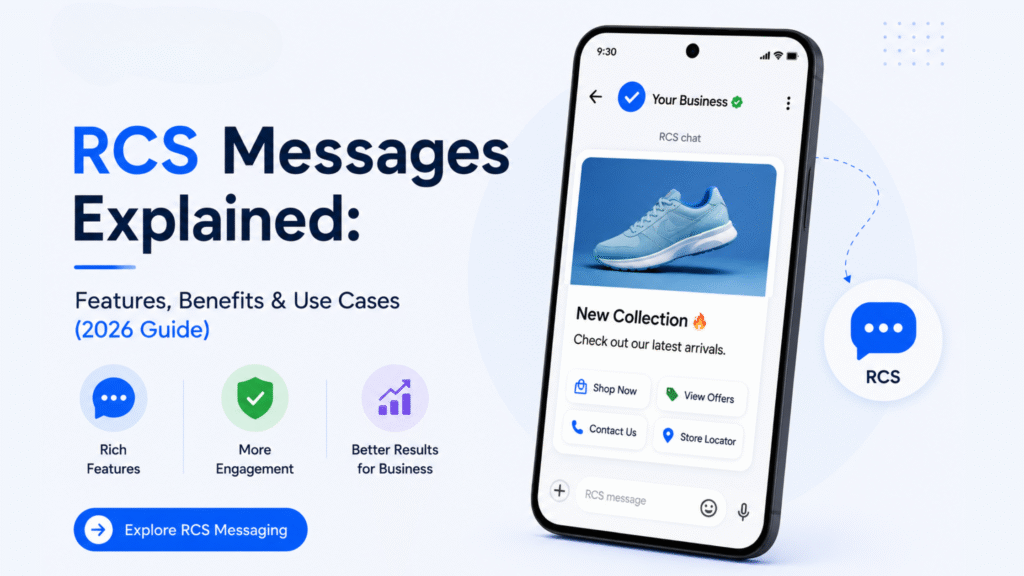
RCS Messages Explained: Features, Benefits & Use Cases (2026 Guide)
Business messaging has evolved far beyond traditional SMS.
Today, customers expect rich, interactive experiences directly on their mobile devices. They want to view products, click buttons, watch videos, and interact with brands without downloading another app.
This is where RCS Messages come in.
RCS (Rich Communication Services) is transforming mobile communication by combining the reliability of SMS with the interactive experience of modern messaging apps.
In this guide, you’ll learn:
- What RCS messages are
- Key RCS features
- Business benefits
- Real-world use cases
- How businesses can start using RCS messaging
What Are RCS Messages?
RCS (Rich Communication Services) is the next generation of SMS messaging.
Unlike traditional SMS, RCS allows businesses to send:
- Images
- Videos
- Product carousels
- Interactive buttons
- Maps
- Payment links
- Verified brand messages
directly to a customer’s messaging app.
Think of RCS as a richer, more engaging version of SMS.
How RCS Messages Work
RCS messages are delivered through supported messaging applications, such as Google Messages on Android devices.
Instead of receiving a plain text message, customers can interact with rich content directly inside the conversation.
For example:
A retail store can send:
- Product images
- Pricing information
- Buy Now button
- Store locator
all within a single message.
Key Features of RCS Messages
1. Rich Media Support
Traditional SMS only supports text.
RCS supports:
- Images
- Videos
- GIFs
- PDFs
- Product catalogs
This creates a more engaging customer experience.
2. Verified Business Profiles
Businesses can display:
- Company name
- Brand logo
- Verification badge
This helps customers identify genuine businesses and reduces fraud concerns.
3. Interactive Buttons
Customers can take action directly from the message.
Examples:
- Buy Now
- Call Now
- Book Appointment
- Visit Website
No need to manually type or search.
4. Carousel Messages
Businesses can showcase multiple products in a swipeable format.
Perfect for:
- E-commerce stores
- Retail brands
- Real estate companies
- Travel businesses
5. Read Receipts
Businesses can see:
- Message delivered
- Message read
This provides better campaign insights compared to SMS.
6. Suggested Replies
Customers can respond with a single tap.
Examples:
- Yes
- No
- Interested
- Call Me Back
This improves engagement rates.
RCS vs SMS
| Feature | SMS | RCS |
|---|---|---|
| Text Messages | ✅ | ✅ |
| Images & Videos | ❌ | ✅ |
| Interactive Buttons | ❌ | ✅ |
| Product Carousels | ❌ | ✅ |
| Read Receipts | ❌ | ✅ |
| Verified Brand Profile | ❌ | ✅ |
| Rich Customer Experience | ❌ | ✅ |
RCS offers significantly more functionality than traditional SMS.
Benefits of RCS Messaging for Businesses
Higher Customer Engagement
Rich content naturally attracts more attention than plain text messages.
Businesses often experience:
- Higher click-through rates
- Better customer interaction
- Improved campaign performance
Better Brand Trust
Verified sender profiles help customers trust the message source.
Customers can instantly recognize:
- Brand logo
- Company name
- Verified status
Increased Conversion Rates
Interactive messaging makes it easier for customers to take action.
Examples:
- Make purchases
- Book appointments
- Request callbacks
- View offers
Improved Customer Experience
Customers can access information directly inside the message without visiting multiple websites or applications.
Better Campaign Analytics
Businesses can track:
- Delivery status
- Read rates
- Click performance
- Customer actions
This helps improve future campaigns.
Top RCS Use Cases Across Industries
E-commerce & Retail
Businesses use RCS for:
- Product launches
- Flash sale promotions
- Personalized recommendations
- Cart recovery campaigns
Example:
A fashion brand sends a carousel featuring:
- New arrivals
- Pricing
- Shop Now buttons
Banking & Financial Services
Banks use RCS for:
- Transaction alerts
- Loan offers
- Credit card promotions
- Fraud notifications
Verified branding increases trust.
Healthcare
Hospitals and clinics send:
- Appointment reminders
- Health check-up offers
- Prescription notifications
- Lab report updates
Education
Schools and colleges use RCS for:
- Admission updates
- Event invitations
- Fee reminders
- Exam notifications
Travel & Hospitality
Travel businesses use RCS for:
- Flight updates
- Boarding passes
- Hotel booking confirmations
- Travel offers
Real Estate
Real estate companies send:
- Property images
- Virtual tours
- Project brochures
- Site visit booking buttons
RCS vs WhatsApp Business Messaging
| Feature | RCS | |
|---|---|---|
| Rich Media | ✅ | ✅ |
| Verified Branding | ✅ | ✅ |
| Interactive Buttons | ✅ | ✅ |
| App Installation Required | No | Yes |
| Reach | Supported Devices | WhatsApp Users |
| Customer Experience | High | High |
Many businesses use both channels as part of a multi-channel communication strategy.
How to Start Using RCS Messaging
Step 1: Choose an RCS Messaging Provider
Businesses often work with providers such as
MagicText
to launch RCS campaigns.
Step 2: Verify Your Business
Register:
- Brand name
- Logo
- Business details
for verification.
Step 3: Design Rich Campaigns
Create:
- Images
- Videos
- Product cards
- Interactive buttons
Step 4: Launch & Track Performance
Monitor:
- Open rates
- Click rates
- Customer engagement
- Conversions
Challenges of RCS Messaging
Businesses should consider:
- Device compatibility varies
- Setup is more advanced than SMS
- Campaign design requires rich content
However, adoption continues to grow rapidly worldwide.
Future of RCS Messaging
As customer expectations evolve, businesses are moving toward more interactive communication channels.
RCS combines:
- SMS reliability
- App-like functionality
- Brand verification
- Rich media experiences
making it one of the most promising messaging technologies for customer engagement.
In a Nutshell
RCS messaging is redefining business communication.
With rich media, interactive buttons, verified branding, and better engagement opportunities, RCS offers a significant upgrade over traditional SMS.
For businesses looking to improve customer communication, increase conversions, and create more engaging messaging experiences, RCS is becoming an essential channel in 2026.
FAQ
1. What are RCS messages?
RCS messages are advanced mobile messages that support images, videos, buttons, carousels, and interactive customer experiences.
2. How is RCS different from SMS?
RCS supports rich media, verified branding, read receipts, and interactive features, while SMS is limited to text-based communication.
3. What are the benefits of RCS messaging for businesses?
RCS improves engagement, builds trust, increases conversions, and provides better customer experiences through interactive messaging.
4. Can businesses send promotional campaigns using RCS?
Yes. Businesses use RCS for product launches, promotions, flash sales, appointment reminders, and customer engagement campaigns.
5. Is RCS messaging available in India?
Yes. RCS adoption is increasing rapidly in India, especially among businesses looking for richer customer communication channels.
6. Which industries benefit most from RCS messaging?
Retail, e-commerce, banking, healthcare, education, travel, hospitality, and real estate businesses commonly use RCS messaging.
7. Can RCS messages include images and videos?
Yes. RCS supports images, videos, GIFs, documents, and interactive content.
8. Is RCS messaging secure?
Yes. Verified business profiles help customers identify authentic brands and reduce the risk of fraudulent messages.
9. Does RCS require a separate mobile app?
No. RCS works through supported messaging apps, such as Google Messages, on compatible devices.
10. How can businesses start using RCS messaging?
Businesses can partner with an RCS provider, verify their brand, create rich messaging campaigns, and start engaging customers through interactive messaging.