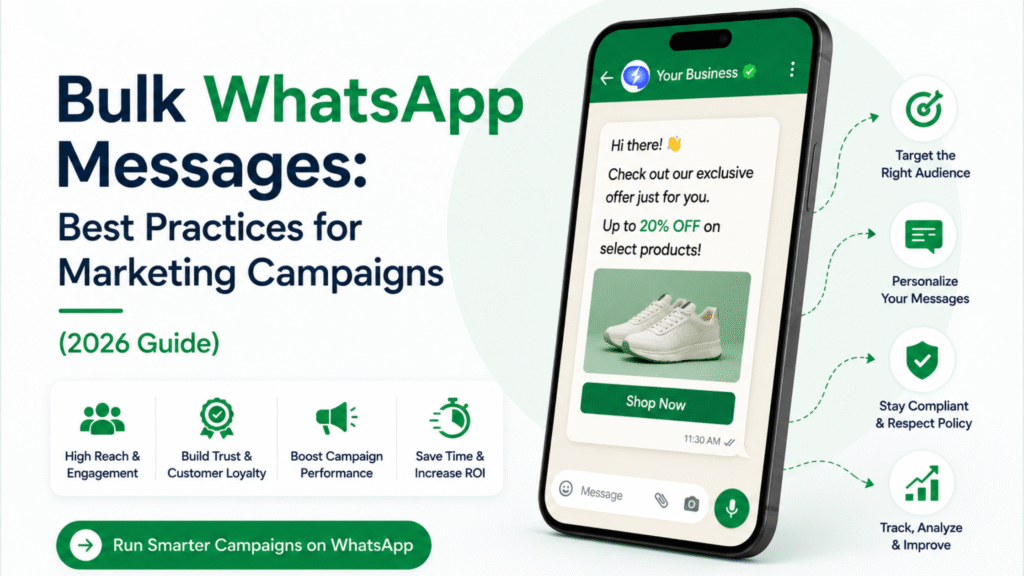
Bulk WhatsApp Messages: Best Practices for Marketing Campaigns (2026 Guide)
WhatsApp has become one of the most powerful marketing channels for businesses. With billions of active users and exceptionally high open rates, it offers a direct way to connect with customers, promote products, and drive sales.
However, sending Bulk WhatsApp Messages successfully requires more than just broadcasting offers. Businesses must follow WhatsApp policies, use customer-friendly communication, and implement smart campaign strategies to maximize results.
In this guide, you’ll learn the best practices for running effective WhatsApp marketing campaigns in 2026.
Why Businesses Use Bulk WhatsApp Messages
Businesses across industries use WhatsApp because it offers:
- High message open rates
- Instant customer communication
- Rich media support
- Better engagement than email
- Faster customer responses
- Higher conversion opportunities
From e-commerce and healthcare to education and real estate, WhatsApp is becoming a key customer communication channel.
What Are Bulk WhatsApp Messages?
Bulk WhatsApp messaging refers to sending messages to multiple customers simultaneously using:
- WhatsApp Business App (limited scale)
- WhatsApp Business API (large-scale campaigns)
Businesses use bulk messaging for:
- Promotional offers
- Product launches
- Event invitations
- Appointment reminders
- Customer engagement
- Lead nurturing
1. Use the Official WhatsApp Business API
The first rule of successful WhatsApp marketing is using the official platform.
Avoid:
- Unofficial bulk messaging software
- Modified WhatsApp applications
- Unauthorized automation tools
These can lead to:
- Message delivery issues
- Number restrictions
- Account suspension
Businesses typically use providers such as MagicText to access official WhatsApp Business API services.
2. Collect Customer Opt-Ins
Customer consent is essential.
Before sending marketing messages, customers should explicitly agree to receive WhatsApp communication.
Opt-in methods include:
- Website forms
- Lead generation campaigns
- Checkout pages
- QR codes
- WhatsApp click-to-chat links
Customers who opt in are more likely to engage positively with your messages.
3. Segment Your Audience
Not every customer should receive the same message.
Segment customers based on:
- Purchase history
- Location
- Interests
- Customer lifecycle stage
- Previous engagement
Segmentation improves relevance and campaign performance.
Example
Instead of sending:
“Flat 20% OFF on all products.”
Send:
“Hi Priya, enjoy 20% OFF on our latest women’s collection.”
Personalization improves engagement significantly.
4. Use Approved Message Templates
For outbound marketing campaigns, WhatsApp Business API requires approved templates.
Templates may include:
- Promotional offers
- Event reminders
- Product updates
- Appointment confirmations
Well-designed templates improve delivery and compliance.
5. Keep Messages Short and Clear
Customers prefer concise communication.
A good marketing message should:
- Grab attention quickly
- Communicate value clearly
- Include a call-to-action
Example
🎉 Weekend Sale!
Get up to 30% OFF on selected products.
👉 Shop Now
Avoid long paragraphs and unnecessary information.
6. Use Rich Media Effectively
WhatsApp supports:
- Images
- Videos
- PDFs
- Product catalogs
Rich media often generates higher engagement than text-only messages.
Examples:
- Product launch videos
- Offer banners
- New collection images
- Brochures
Use media strategically to support your message.
7. Include Strong Call-to-Action (CTA)
Every campaign should guide customers toward an action.
Examples:
- Shop Now
- Book Appointment
- Claim Offer
- Download Brochure
- Contact Us
Clear CTAs improve conversions.
8. Avoid Over-Messaging
One of the fastest ways to lose customers is sending too many messages.
Recommended frequency:
Promotional Campaigns
1–4 messages per week
Transactional Updates
As required
Focus on quality rather than quantity.
9. Monitor Campaign Performance
Track important metrics:
- Delivery rate
- Open rate
- Click-through rate
- Response rate
- Conversion rate
Regular analysis helps improve future campaigns.
10. Automate Customer Follow-Ups
Automation helps businesses scale communication.
Examples:
- Lead nurturing
- Cart recovery
- Appointment reminders
- Feedback collection
Automation ensures customers receive timely communication.
11. Use Chatbots for Better Engagement
WhatsApp chatbots can:
- Answer FAQs
- Qualify leads
- Share product information
- Schedule appointments
Combining chatbots with human support creates a better customer experience.
12. Make Opt-Out Easy
Customers should always have the option to stop receiving messages.
Examples:
Reply STOP to unsubscribe.
Reply REMOVE to opt out.
Respecting customer preferences improves trust and compliance.
Common WhatsApp Marketing Mistakes
❌ Sending messages without consent
❌ Using purchased databases
❌ Over-promoting products
❌ Ignoring customer responses
❌ Sending irrelevant offers
❌ Using unofficial tools
Avoiding these mistakes improves campaign performance and protects account health.
Industries Successfully Using Bulk WhatsApp Marketing
E-commerce
- Product launches
- Cart recovery
- Flash sales
Healthcare
- Appointment reminders
- Health campaign promotions
Education
- Admission updates
- Event notifications
Real Estate
- Property promotions
- Site visit scheduling
Retail
- New arrivals
- Loyalty offers
- Seasonal campaigns
Bulk WhatsApp Marketing Strategy for 2026
A successful campaign typically follows this process:
Step 1
Collect customer opt-ins
Step 2
Segment audience
Step 3
Create approved templates
Step 4
Send personalized campaigns
Step 5
Track performance
Step 6
Automate follow-ups
This structured approach delivers better results and reduces customer complaints.
Why Businesses Choose Integrated Communication Platforms
Businesses increasingly prefer platforms that combine:
- WhatsApp Business API
- Bulk SMS
- Voice Calls
- RCS Messaging
- Automation Tools
Solutions such as MagicText
allow businesses to manage multiple communication channels from a single platform.
In a Nutshell
Bulk WhatsApp messaging can be one of the highest-performing marketing channels when used correctly.
Success comes from:
- Customer consent
- Personalization
- Relevant content
- Smart automation
- Consistent optimization
Businesses that focus on providing value rather than simply sending promotions are the ones that achieve long-term success with WhatsApp marketing.
FAQ
1. What are bulk WhatsApp messages?
Bulk WhatsApp messages are messages sent to multiple customers simultaneously using WhatsApp Business tools or WhatsApp Business API.
2. Is it legal to send bulk WhatsApp marketing messages?
Yes, provided customers have opted in and the messages comply with WhatsApp's business policies.
3. What is the best way to send bulk WhatsApp messages?
The safest and most scalable method is through the official WhatsApp Business API.
4. How often should businesses send WhatsApp marketing messages?
Most businesses perform well with 1–4 promotional messages per week, depending on customer engagement levels.
5. Can WhatsApp messages include images and videos?
Yes. WhatsApp supports rich media such as images, videos, documents, and product catalogs.
6. Why is customer opt-in important?
Opt-in ensures customers have agreed to receive messages, improving engagement and reducing spam complaints.
7. Can WhatsApp marketing be automated?
Yes. Businesses can automate follow-ups, reminders, lead qualification, and customer support using WhatsApp automation tools.
8. What industries benefit most from WhatsApp marketing?
E-commerce, retail, healthcare, education, real estate, and financial services commonly use WhatsApp marketing.
9. How can businesses improve WhatsApp campaign performance?
Use audience segmentation, personalization, rich media, strong CTAs, and performance tracking.
10. Can bulk WhatsApp messages increase sales?
Yes. When targeted correctly, WhatsApp campaigns can improve customer engagement, conversions, repeat purchases, and overall sales performance.