Improve Patient Communication with WhatsApp API for Hospitals & Clinics in Tamil Nadu
When it comes to healthcare, having “nice-to-have” communication is simply not good enough. Missing appointments, delayed reports, unresolved questions, and unclear information all impact patient trust and treatment. The state of Tamil Nadu is a region of patients who demand speedy and familiar communication, and WhatsApp has become their best means to fill that gap simply.
WhatsApp API enables hospitals and clinics to communicate effectively, securely, and in large numbers without adding extra pressure on the reception and call centre desks. Here’s how health facilities in the State of Tamil Nadu utilize this technology solution.
Why WhatsApp Works So Well for Healthcare Communication
Patients already use WhatsApp on a daily basis. There is no learning curve, and no download or login is required.
For hospitals and clinics, the following are offered by WhatsApp API:
- High message open rates.
- Instant delivery
- Two-way Communication
- Automation with control
- Variations
- Secure, verified business messaging
It makes it perfect for communication with patients.
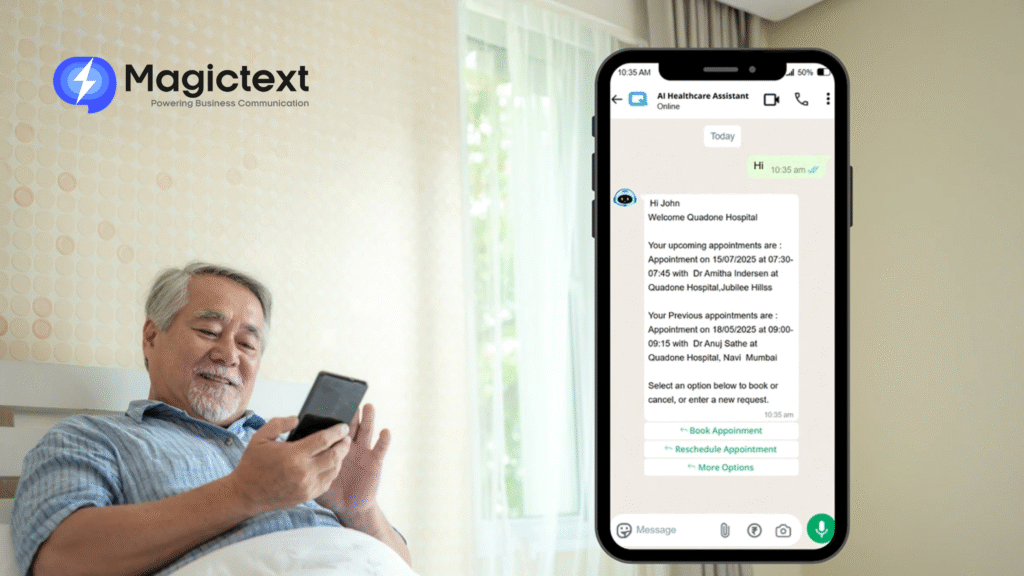
1. Booking, Confirmation, and Reminder of Appointments
“No shows” are a significant problem for clinics and hospitals. This is reduced by using the WhatsApp API.
What you can automate:
- Appointment booking confirmation
- Reminder notifications for one day or one hour before
- Reschedule or Cancel options by buttons
Example
Your appointment with Dr. Kumar is fixed for tomorrow, 10:30 AM.
[Confirm] [Reschedule]
“Patients appreciate reminders, whereas doctors appreciate improved schedules.”
2. Lab Reports & Test Result Notifications
Patients often call hospitals just to ask whether reports are ready. WhatsApp reduces all these hassles.
How it Helps:
- Inform patients that their reports are ready
- Distribute Links to Download Secure Reports
- Decrease queue & counter pressure
- This ensures that sensitive information is managed while convenience is enhanced.
3. Prescription & Follow-up Care Communication
Follow-up care after consultation is where communication tends to fail. This is where WhatsApp retains its hold on patients after they are discharged from hospitals.
Use cases:
- Share electronic prescriptions
- Follow-Up Reminders
- Taking medication reminders
- Diet or Care Instructions
It increases compliance with treatment regimes and patient outcomes.
4. OPD/IPD & Surgery Updates for Families
For families waiting in consultation rooms or hospitals, this information helps reduce anxiety.
Messages may contain:
- Doctor availability updates
- Surgical start and end notifications
- Discharge notifications
- Room transfer updates Links to
“And clear updates will do much more than keep people informed: They will build trust
5. Billing, Payment Links, and Insurance Coordination
WhatsApp API can make financial communication less awkward with phone calls.
Examples:
- Bill ready notice
- Secure Payment Links
- Insurance document requests
- Payment confirmation notifications
It decreases delays, making it more transparent.
6. Health Campaigns & Preventive Care Awareness
In Tamil Nadu, hospitals and clinics are using WhatsApp for health outreach.
Campaign ideas:
- Vaccination reminders
- Free health camps announcements
- Seasonal illness awareness
- Follow-ups for chronic care cases
“These messages are informative, not promotional—when done correctly,” says Spital
7. Patient Feedback & Experience Surveys
The feedback provided by patients is imperative and is usually overlooked because of inconvenient forms to fill.
WhatsApp makes feedback easy:
- Rating buttons in quick form
- Simple follow-up questions
- Surveys for post-visit
The higher the response rate, the more insightful and the quality of services provided will be enhanced
8. Multilingual Communication (Tamil + English)
The diverse nature of the population of Tamil Nadu calls for linguistic adaptability. The following are
- Tamil-only messages
- English messages
- Neutral Tamil-English communication
A patient can better comprehend instructions if the messages are in his or her native language.
Data Security and Compliance Issues
The messaging in health care must be secure.
WhatsApp API allows:
- Business accounts verified by the user
- Encrypted communication
- Controlled access
- Messaging that involves templates
When effectively integrated, there is a good merger with patient data protection practices.
Conclusion
Effective communication translates to effective care. For healthcare facilities in the state of Tamil Nadu, the WhatsApp API is more than a communication application; it is a patient experience solution. Starting with reminder notifications for follow-ups, billing notifications, and health awareness notifications on WhatsApp, medical service providers remain connected, organised, and trusted. When patients feel informed and supported, they don’t just come back they refer.