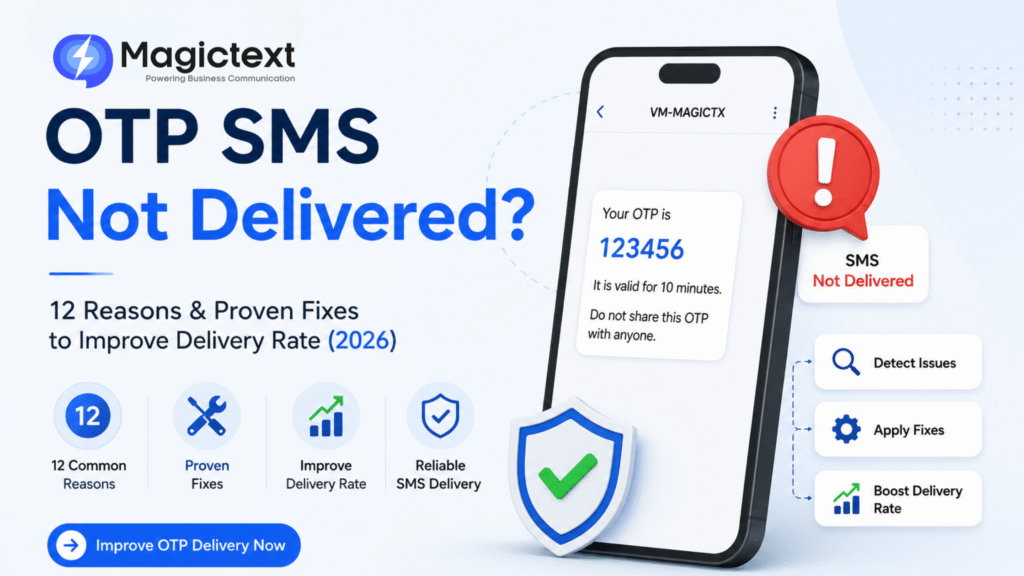
OTP SMS Not Delivered? 12 Reasons & Proven Fixes to Improve Delivery Rate (2026)
OTP delivery failures are one of the biggest problems businesses face today.
A delayed or failed OTP can lead to:
- Failed logins
- Lost transactions
- Customer frustration
- Increased support tickets
- Revenue loss
And in industries like banking, e-commerce, fintech, healthcare, and logistics, OTP delivery directly impacts business operations.
So why do OTP SMS messages fail?
Let’s break down the 12 most common OTP SMS delivery issues and the proven fixes businesses use to improve delivery rates in 2026.
Why OTP Delivery Matters
OTP (One-Time Password) messages are time-sensitive.
Customers expect them within seconds.
Even a delay of 20–30 seconds
can increase:
- User drop-offs
- Payment failures
- Login abandonment
Fast delivery is critical.
1. DLT Template Mismatch
Problem
The live OTP message doesn’t exactly match the approved DLT template.
Example:
Approved:
Your OTP is {#var#}
Sent:
Your login OTP is 4587
Telecom operators may reject the SMS.
Fix
- Use exact approved template format
- Avoid changing wording
- Keep variables in correct position
This is one of the most common rejection reasons in India.
2. Wrong SMS Route Selection
Problem
Some businesses mistakenly send OTPs through promotional routes.
Promotional routes:
- Are slower
- Have timing restrictions
Fix
Always use:
- Transactional route
- Service implicit route
for OTP delivery.
3. Poor Telecom Routing
Problem
Low-quality providers often use weak or overloaded telecom routes.
This causes:
- Delays
- Failures
- Inconsistent delivery
Fix
Choose providers with:
- Direct telecom connectivity
- Optimized routing
- High-priority OTP infrastructure
Platforms like MagicText focus on optimized OTP routing for faster delivery.
4. Mobile Number on DND
Problem
Some users are registered under DND preferences.
Though transactional OTPs are usually allowed, misconfigured routes may still fail.
Fix
Ensure OTP messages are:
- Properly categorized as transactional
- Sent through compliant channels
5. Network Congestion
Problem
During peak traffic periods:
- Festivals
- Sales events
- Banking rush hours
telecom networks may slow down.
Fix
- Use load-balanced routing
- Multi-operator connectivity
- High-throughput SMS gateways
Enterprise-grade providers handle this better.
6. Invalid or Incorrect Mobile Numbers
Problem
OTP fails if:
- Number format is wrong
- Country code missing
- Number inactive
Fix
Validate numbers before sending:
- Format check
- Active number verification
- Duplicate filtering
7. Mobile Device Issues
Problem
Sometimes the issue is on the customer side:
- Full inbox
- Airplane mode
- Poor signal
- SMS blocked
Fix
Provide:
- “Resend OTP” option
- Voice OTP backup
- WhatsApp OTP alternative
Multi-channel verification improves success rates.
8. SMS Content Filtering
Problem
Telecom systems may flag suspicious content.
Triggers include:
- Excessive symbols
- Spam-like wording
- Shortened links
Fix
Keep OTP messages:
- Simple
- Clean
- Professional
Example:
Your OTP is 4587. Valid for 5 minutes.
9. Slow API Response Time
Problem
Even before telecom delivery, slow APIs can delay OTP initiation.
Fix
Use providers with:
- Fast API infrastructure
- High uptime
- Low latency
API speed matters as much as telecom routing.
10. SIM Restrictions or Blocking
Problem
Some users:
- Block unknown senders
- Use SMS filtering apps
Fix
Use:
- Recognizable sender IDs
- Consistent branding
This improves trust and visibility.
11. International SMS Delivery Issues
Problem
International OTP delivery may fail due to:
- Country restrictions
- Carrier filtering
- Weak global routing
Fix
Use providers with:
- Global telecom partnerships
- International OTP routing optimization
12. No Backup Authentication Method
Problem
Businesses relying only on SMS create risk.
If SMS fails, login fails.
Fix
Add backup options:
- WhatsApp OTP
- Voice OTP
- Email OTP
- Authentication apps
Multi-channel verification improves reliability significantly.
Proven Strategies to Improve OTP Delivery Rate
Use Transactional SMS Routes
Always prioritize transactional infrastructure.
Optimize DLT Compliance
Template mismatch is a major failure reason.
Choose High-Quality Providers
Cheap routing often causes expensive failures.
Add Multi-Channel Verification
SMS + WhatsApp + Voice = better success rate.
Monitor Delivery Reports
Track:
- Failure rates
- Delay patterns
- Operator performance
Analytics help improve performance continuously.
OTP Delivery Best Practices in 2026
- Keep OTP messages under 160 characters
- Avoid links in OTP SMS
- Use clear sender IDs
- Enable retry logic
- Provide resend option
- Set OTP expiry clearly
Small optimizations improve customer experience significantly.
Why Businesses Use Integrated Platforms
Businesses increasingly use platforms like MagicText
because they offer:
- OTP SMS delivery
- WhatsApp OTP
- Voice OTP backup
- API automation
- DLT compliance support
- Real-time analytics
This reduces delivery failures and improves authentication success rates.
Final Thoughts
OTP delivery is no longer just a technical issue—it’s a business-critical function.
A failed OTP can mean:
- Lost customers
- Failed transactions
- Poor user experience
Most OTP delivery failures happen because of:
- DLT mismatch
- Poor routing
- Wrong SMS configuration
- Lack of backup channels
By fixing these issues and using reliable communication infrastructure, businesses can dramatically improve OTP delivery performance in 2026.
Frequently Asked Questions
1. Why is my OTP SMS not getting delivered?
OTP SMS may fail due to DLT template mismatches, incorrect SMS routing, network congestion, invalid mobile numbers, telecom filtering, or device-related issues. Identifying the exact cause is essential to improve delivery rates.
2. How long should an OTP SMS take to arrive?
Most OTP messages should be delivered within a few seconds. Delays beyond 20–30 seconds can negatively impact login success, payment completion, and customer experience.
3. What is the most common reason for OTP delivery failure in India?
One of the most common reasons is a DLT template mismatch, where the SMS content sent does not exactly match the approved DLT template registered with telecom operators.
4. Can OTP messages be blocked by DND settings?
Transactional OTP messages are generally exempt from DND restrictions. However, incorrect route configuration or compliance issues can sometimes affect delivery.
5. Which SMS route should be used for OTP delivery?
Businesses should use Transactional SMS Routes or Service Implicit Routes specifically designed for time-sensitive communications like OTPs.
6. Why are OTP messages delayed during peak hours?
Telecom networks may experience congestion during festivals, flash sales, banking peak hours, or major events, causing temporary delivery delays.
7. How can businesses improve OTP delivery rates?
Businesses can improve OTP delivery by ensuring DLT compliance, using transactional routes, selecting reliable SMS providers, monitoring delivery reports, and implementing backup verification channels.
8. Is WhatsApp OTP more reliable than SMS OTP?
WhatsApp OTP can serve as an effective backup channel when SMS delivery is delayed or unsuccessful. Many businesses use both SMS and WhatsApp OTP to increase authentication success rates.
9. Why do international OTP messages sometimes fail?
International OTP failures can occur due to carrier filtering, country-specific regulations, network restrictions, or poor global routing infrastructure.
10. What should an ideal OTP SMS message look like?
A simple OTP message works best, such as:
"Your OTP is 4587. Valid for 5 minutes. Do not share it with anyone."
Avoid links, excessive symbols, and promotional language.
A simple OTP message works best, such as: "Your OTP is 4587. Valid for 5 minutes. Do not share it with anyone." Avoid links, excessive symbols, and promotional language.
Businesses can improve OTP SMS delivery rates by maintaining DLT compliance, using transactional SMS routes, choosing direct telecom-connected providers, validating mobile numbers, monitoring delivery reports, and implementing backup channels such as WhatsApp OTP and Voice OTP. These practices help reduce delivery failures and improve user authentication success rates.